How does NLP work with hypnotherapy?
NLP and hypnotherapy can be powerful tools for understanding patterns of thinking and behaviour and working towards meaningful personal change.
But what is NLP, and how does it work alongside hypnotherapy?
NLP stands for Neuro-Linguistic Programming.
Put simply, NLP looks at the connection between the way we think, communicate and behave.
Neuro - the way we think
Linguistic – the way we communicate
Programming - the way we respond or behave
Throughout our lives, we develop patterns in the way we think and respond to different situations. Some of these patterns are helpful and support us.
Others can become unhelpful habits that may affect our confidence, behaviour or ability to achieve the changes we want.
NLP provides a way of exploring these patterns and developing more useful ways of thinking and responding.
The way we talk to ourselves, the meaning we give to experiences and the way we respond to particular situations can all influence our behaviour.
For example, you might find yourself thinking, or even saying “I can't do this” whenever you face a particular challenge.
Perhaps you've thought this many times before.
It may have become an automatic response.
NLP can help you explore the pattern behind the thought and consider whether there’s a different and more useful way to approach the situation.
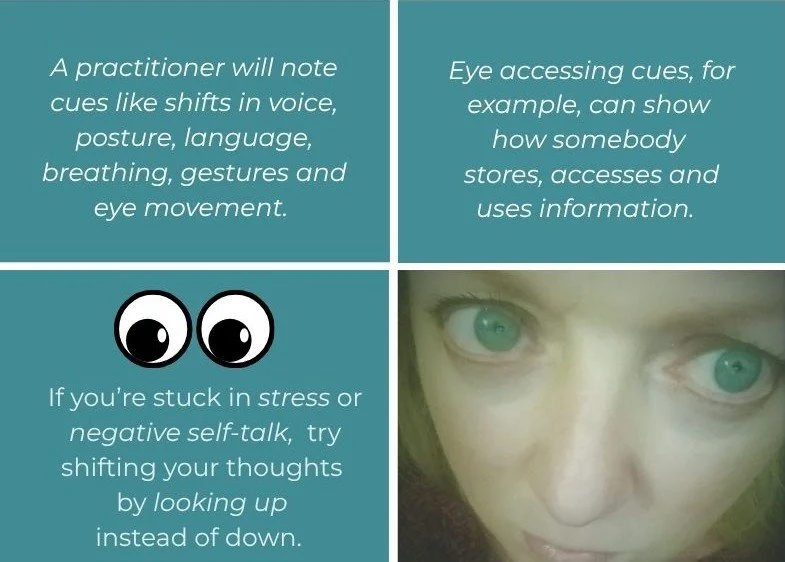
Eye Accessing cues in NLP
How Does NLP Work With Hypnotherapy?
NLP and hypnotherapy can complement each other well.
Hypnotherapy uses a relaxed and focused state of attention to help you work with your thoughts, feelings and behaviours.
NLP can be used to explore the patterns that may be influencing those thoughts and behaviours.
When used together, they provide different ways of looking at what might be keeping an unwanted habit or behaviour in place.
For example, someone wanting to make a change might understand, logically, what they want to do but find themselves still responding in the same habitual way.
Exploring the thinking and behavioural pattern through NLP can help bring greater awareness to what is happening.
Hypnotherapy can then provide an opportunity to reinforce the changes the person wants to make while in a relaxed and focused state.
It's Not About Simply Thinking Positively
One of the misconceptions about changing your thinking is that you simply need to “think positive”.
Realistically, meaningful change is more complicated than that.
It's about understanding what is happening for you now.
What are you thinking?
What are you saying to yourself?
What situations trigger particular responses?
What habits have developed over time?
And perhaps most importantly, what would you like to be different?
By developing greater awareness of these patterns, you can begin to consider different ways of responding.
Why a Personalised Approach Matters
Everyone is different.
The reasons behind a habit, behaviour or way of thinking are unique to the individual.
That's why I don't believe in a one-size-fits-all approach to hypnotherapy or NLP. When I work with a client, we start by understanding what they want to change and what they would like to achieve.
From there, we can identify the thoughts, behaviours or patterns that may be getting in the way and decide which strategies may be most appropriate.
Hypnotherapy and NLP are simply two of the tools I can use as part of this personalised approach.
The aim is to help you develop greater awareness, confidence and practical strategies that support the changes you want to make.
Could Hypnotherapy and NLP Help You?
If you've tried to make changes before but found yourself returning to the same patterns, it may be helpful to look at what is happening beneath the surface.
Whether you're ready to change an unwanted habit or behaviour, improve your confidence, manage anxiety, change your relationship with food, quit smoking or vaping, get better sleep, or make another personal change, the first step is understanding what you want to be different.
From there, we work together to develop an approach that is suited to you, your goals and your circumstances.
Are you ready for change?